An evocative photo caught my eye whilst googling free-to-use images for a work presentation the other day. (You know how it is: you start off hunting for pictures of ‘businesspeople in meetings’, and your fingers accidentally type ‘public flogging’):
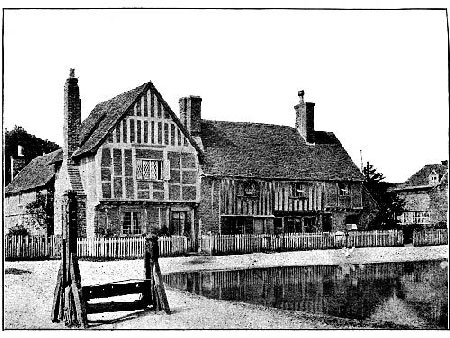
The photograph comes from a 1931 book on entitled ‘Bygone Punishments’ (of which we actually own an earlier copy, dating from 1899, without the illustration in question). The commentary explains that we’re looking at the “Stocks and whiping-post, Aldbury, from a photo by A. Whitford Anderson, Esq., Watford”:
“A half-timbered house, probably Tudor, beside a pond; in the foreground are wooden stocks, with the somewhat unevenly placed holes just visible, and one post higher so as to be used as a whipping post… Today Aldbury is part of the Borough of Dacorum. The stocks and whipping-post are still there, but not as complete.”
Now, I’ve seen lots of photos of whipping posts – but never one that’s so evocative of the era in which they were actually put to use. I can just picture a maid, tied to the post, looking out over the duck pond as she was lashed in front of the watching crowd for stealing butter from her master’s kitchen.
The prominence of the apparatus, bang in the centre of the village, also got me thinking. For in a small place like that, it would be quite impossible for the young lass not to have to walk past the scene of her thrashing on an almost-daily basis – the memories and the sense of shame lasting long after her marks had faded.
That’s a good point Abel. In fact, that maid probably walked past the post every day for the remainder of her life.
I think we sometimes forget just how little most people travelled right up into the 18th century.
“(You know how it is: you start off hunting for pictures of ‘businesspeople in meetings’, and your fingers accidentally type ‘public flogging’)”
No, those are just YOUR kinky fingers that do that LOL Mine are behaving far better than that 😛
These days the perfect person to be tied to a whipping post would be Sarah Palin. Up would go her dress, down would come her knickers, and the birch, cane, or whip would flog her bare bottom most painfully
So where’s Aldbury? And is said post still there??
Google Maps shows it as being near Tring. The satellite image shows Stocks Road, leading past the pond.
And OMG – the local morris dancers’ site (!) states:
“The village stands at the foot of the Chiltern hills, with the magnificent woods of Ashridge climbing above. It remains very picturesque, centred around its pond and green, the latter indulgently equipped with whipping post and stocks.”
The local council’s site states:
“The picturesque village of Aldbury lies 3 miles east of Tring, at the foot of a Chiltern ridge, and is almost surrounded by the Ashridge estate which is owned by the National Trust. The village green with its pond, stocks and whipping post is the centre of the village.”
And here’s a recent photo:
http://www.tring.gov.uk/info/places/aldbury.jpg
I think a trip might be called for?
(OMG I *so* should be working, not looking up whipping posts online!!)
I don’t think I’d dare go in a trip there with you, judging by what happened to Jessica on another recent outing of yours! And no, you shouldn’t be perving while you’re working. Bad Abel.
I wish they would bring back the whipping post, there’s many a naughty lady these days that need to have their bottoms bared, for a painfull taste of the whip. Don’t you agree Abel.
@Eliane: but it sounds like such a lovely day out!
@sixofthebest: The whipping post’s never gone away in our kinky world! The real world’s a bit of a different matter…
Well, the Chilterns are a beautiful part of the world, I might be persuaded. Though only if there was a general agreement to avoid the nearby Ashridge Estate, which doubtless has birch tress mixed in with the more famous beech ones!
Pingback: chross.blogt.ch - Chross Guide To The Spanking Internet
Those stocks are still there but a little worse for wear. In the mddle of the very pictureque village. Nice to look at but not the most practical to use. Ashridge estate is huge and its easy to find a quieter more secluded spot 😉
@ Purple Sky – do tell more!!!
Ashridge is wooded. There are main paths that can get busy but there are really quiet hardly used areas with random fallen logs (good for bending over) and obviously lots of handy impliments lying around. Not that I know any of this from experience just theory!
Wow, “The One Show” on BBC1 just showed stocks – I think the one in our photo – with Dan Snow holding a cat and talking about “whipping, flogging and flagellation”. Haron: down girl!
I had missed this which was publshed before my article around the same time.
The stocks (as pictured in your post) are very common in Engalnd and in use in many places up until the 1930s. The pillory (which is much more interesting) far less common.
Thanks for that, I would have referenced this article had I seen it sooner.
DJ
@DJ – thanks for the comment. Folks: do click on the “DJ Black” link above, if you happen to see this – “A Voice in the Corner” is one of the very, very best spanking blogs out there if you don’t already know it.
Thanks for the vote of confidence Abel
I wish there was a whipping post or a naval ship that reanacted whippings not at the fury to leave scars but to leave welts that could be enjoyed for a week of honor and like you said to a see barefoot wench receiving just punishment would be lovely.
@dirty soles – thanks for the comment: always good to hear from new commenters. I think there are probably plenty of re-enactments of such whippings – LOL but in private scenes rather than in public!